

Table of Contents
- Why Plus Size Boot Sleeve Sizing Works Differently
- How to Measure Thigh Circumference for Boots
- Stretchy Boot Sleeves for Thick Thighs: What to Look For
- How a Plus Size Boot Sleeve Should Feel When Fitted Correctly
- Plus Size Boot Hacks for Sliding Sleeves
- Sizing Chart: Finding Your Boot Sleeve Size by Measurement
- Common Boot Sleeve Fitting Mistakes to Avoid
- Conclusion
Last Updated: August 17, 2026
Why Plus Size Boot Sleeve Sizing Works Differently
A plus size boot sleeve is a stretch fabric accessory that wraps around the lower leg or thigh to transform a heel into a boot, and it sizes completely differently from traditional footwear. Standard boots are sized by shoe length. Boot sleeves are sized by leg circumference. This distinction is why many women with wide calves or full thighs have struggled with zippers that won't close, shafts that cut off circulation, or boots that won't pull on past the ankle.
Most boot-fitting resources focus on foot length and width, treating calf circumference as an afterthought. Boot sleeves flip the entire sizing model. Bootsy sizes its sleeves by thigh and calf measurements, covering a range from 14 inches to 60 inches. Shoe size only determines compatibility with the heel itself, not the fit of the sleeve. A woman who wears a size 8 shoe with a 28-inch calf and a woman with the same shoe size but a 16-inch calf will need completely different sleeve sizes.
How to Measure Thigh Circumference for Boots
Accurate thigh measurement is the single most important step in finding a plus size boot sleeve that fits without slipping or binding. Stand upright with your weight distributed evenly on both feet. Wrap a flexible fabric measuring tape around the fullest part of your thigh, typically about 6 to 8 inches below your hip crease. Keep the tape snug but not compressing the skin. Read the measurement in inches.
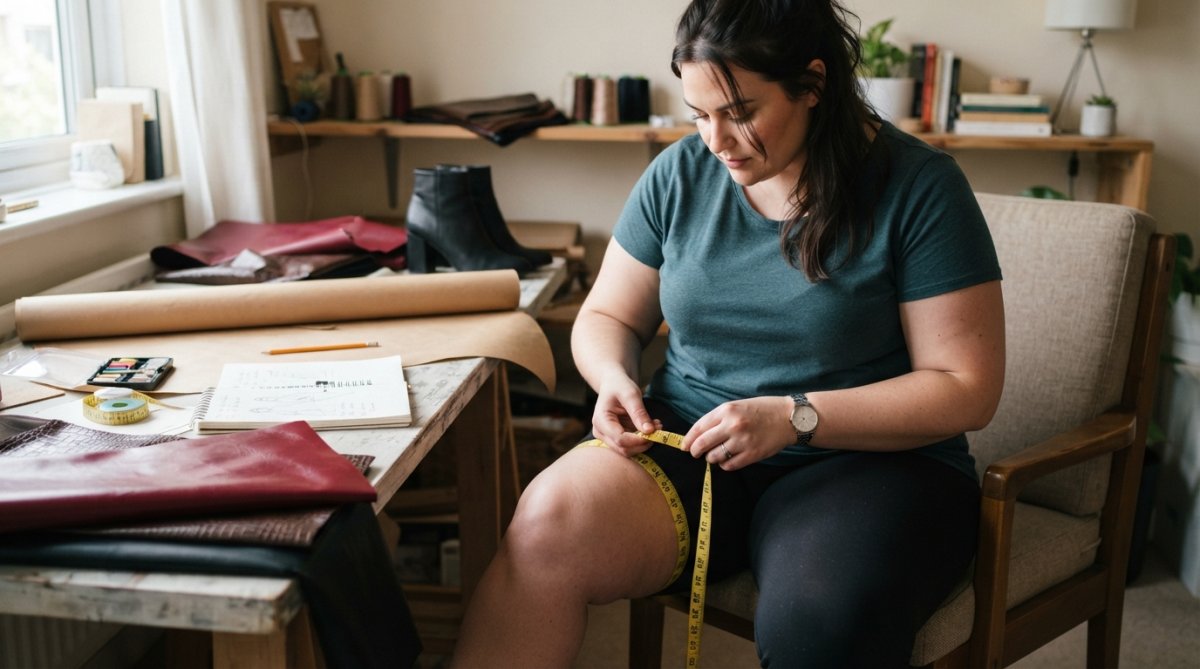
Take the measurement twice and use the larger reading. Measuring in the evening gives a more conservative, reliable number since thigh circumference fluctuates slightly depending on time of day. If you're between sizes, always size up, a sleeve with extra room at the top can be adjusted with the internal grip or layered over thicker tights, while one that's too tight will roll down or restrict movement.
According to guidance from the American Orthopaedic Foot and Ankle Society on proper lower limb measurement, measurements taken at the widest anatomical point give the most reliable fit data for any leg-based garment.
Measuring Your Calf Circumference
Calf circumference is the second critical measurement for boot sleeve fit. Sit in a chair with your foot flat on the floor and your knee bent at 90 degrees. Wrap the tape around the fullest part of your calf, usually about 4 to 5 inches below the back of the knee. Keep the tape parallel to the floor and snug without pinching. Write this number down alongside your thigh measurement, both are required to select the correct sleeve size.
Calf circumference and shoe width are not correlated. Many women with wide calves wear a standard shoe width. Treat your calf measurement as an entirely separate data point.
Shaft Height and Instep Volume
Shaft height refers to how tall the sleeve rises on the leg, from the top of the heel to the upper edge. Thigh-high sleeves extend from just above the knee to mid-thigh or higher. Mid-calf sleeves stop between the ankle and the knee. Your instep volume, the circumference at the top of your foot where it meets the ankle, affects how easily the sleeve slides over the foot and heel. Check that the sleeve's ankle opening measurement, at full stretch, exceeds your instep circumference before ordering.
Stretchy Boot Sleeves for Thick Thighs: What to Look For
Stretchy boot sleeves for thick thighs need to stretch wide enough to accommodate full thigh circumference without rolling down, and return to shape so the sleeve doesn't sag at the knee. The key specification to look for is four-way stretch: the material expands both horizontally and vertically. Horizontal stretch accommodates calf and thigh circumference. Vertical stretch allows the sleeve to move with the leg during walking rather than riding up or pulling down.
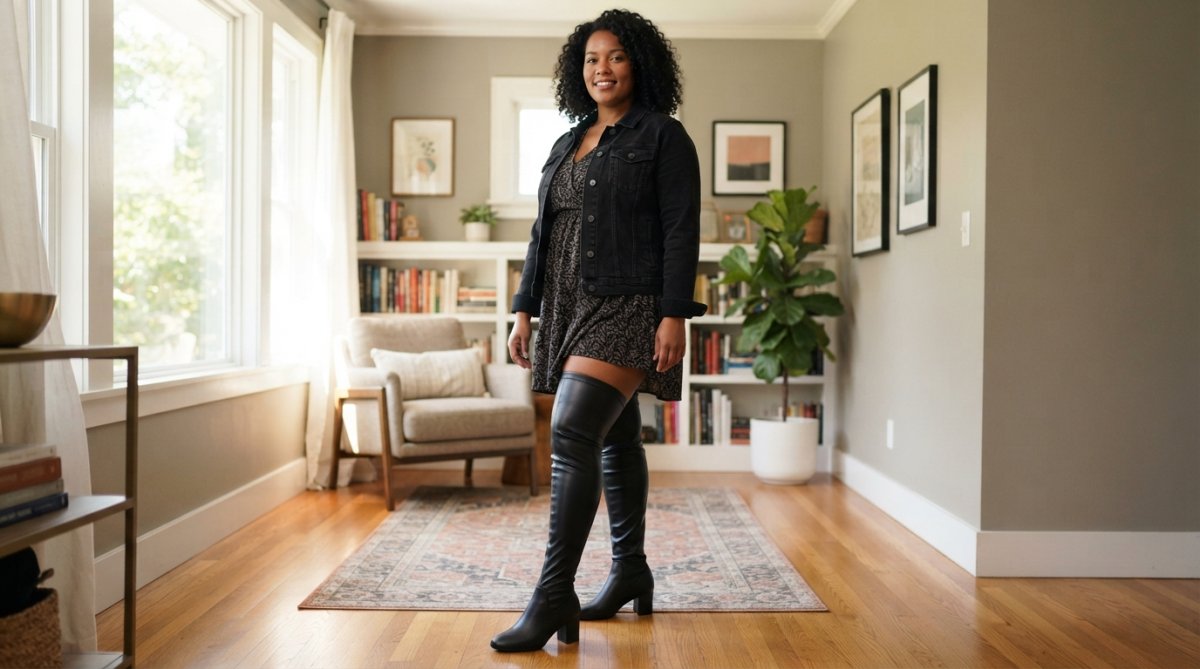
Look for sleeves that specify a maximum circumference in their sizing chart rather than vague terms like "one size fits most." Bootsy's thigh-high sleeves cover thigh sizes from XS through 5X, with measurements up to 60 inches, representing genuine size inclusivity.
Material Stretch Expectations: Faux Leather vs. Vinyl
Stretch faux leather has a soft backing fabric bonded to a polyurethane surface. The backing provides the stretch, while the surface gives the appearance of leather. High-quality faux leather has meaningful four-way stretch and recovers its shape well after repeated wear. The Bootsy Best thigh-high sleeve in black and the Croc sleeve in chocolate crocodile print are both crafted from stretch faux leather, making them well-suited for full calves and thighs.

Stretch vinyl has a higher-gloss finish and is generally slightly firmer. It stretches with more resistance than faux leather, providing more lateral support around the calf. The Bootsy Vamp thigh-high in deep cherry uses high-quality stretch vinyl and is sized XS through 5X.
Both materials have a break-in period of a few wears before they fully conform to your leg shape.
Visual Fit Indicators for Wide Feet and Full Calves
A correctly fitted boot sleeve shows no horizontal stress lines across the calf or thigh. Stress lines indicate the sleeve is too small in circumference. Vertical rippling or sagging at the knee indicates the sleeve is too large or the material lacks sufficient vertical recovery. For wide feet, check the ankle opening. If the sleeve pulls tightly across the top of the foot or creates a visible ridge at the instep, the ankle circumference is too narrow.
How a Plus Size Boot Sleeve Should Feel When Fitted Correctly
A well-fitted plus size boot sleeve should feel like a firm-but-comfortable compression garment: present and snug, but never painful. There should be no pressure points at the back of the knee, no pinching at the top of the thigh, and no sensation of the sleeve cutting into the calf. The sleeve should stay in place through normal walking without adjustment.
According to podiatric fit guidance from the American Podiatric Medical Association, any leg-based garment that creates sustained pressure on the calf or behind the knee should be removed immediately, as it can affect circulation. A properly sized sleeve distributes pressure evenly and allows you to sit, stand, walk, and climb stairs without readjusting.
Plus Size Boot Hacks for Sliding Sleeves
Sliding sleeves are the most common complaint among women with full thighs. The most reliable hack for keeping a boot sleeve in place is wearing it over a thin layer of grip-finish tights or hosiery. Silicone-grip tights create friction between the leg and the sleeve's inner surface that prevents downward migration. This is especially effective for thigh-high sleeves on legs where the thigh tapers significantly from top to bottom.

A second approach is sizing down slightly at the thigh if the sleeve fits comfortably at the calf. For sliding at the ankle, make sure the sleeve's lower edge sits at or just above the top of the shoe's heel counter.
| Problem | Likely Cause | Fix |
|---|---|---|
| Sleeve slides down thigh | Thigh circumference too large for size | Size down or add grip-finish tights |
| Bunching at the knee | Calf too narrow relative to thigh | Look for graduated-fit sleeve |
| Tight at ankle, loose at calf | Low instep volume, narrow ankle | Check ankle opening measurement |
| Stress lines across calf | Calf circumference too large for size | Size up |
| Gaping at heel pocket | Shaft height too long | Try mid-calf style instead |
| Sleeve rolls at the top | Material lacks vertical recovery | Switch to four-way stretch faux leather |
Sizing Chart: Finding Your Boot Sleeve Size by Measurement
Bootsy sizes its sleeves by thigh circumference, which is the primary measurement that determines which size to select. Calf circumference and instep volume are secondary checks to confirm the sleeve will fit the full leg.
| Size | Thigh Circumference | Best For |
|---|---|---|
| XS | 14" - 18" | Petite thighs, slender legs |
| S | 18" - 22" | Average thigh, standard proportions |
| M | 22" - 28" | Fuller thigh, standard to wide calf |
| L | 28" - 34" | Wide thigh, full calf circumference |
| XL | 34" - 42" | Extended sizing, full leg volume |
| 2X | 42" - 48" | Plus-size, wide calf and thigh |
| 3X-5X | 48" - 60" | Maximum inclusive range |
Note: Confirm exact measurements against the product listing before ordering. The product's listed maximum stretch measurement is the definitive number.
For petite users at the lower end of a size range, sizing down gives a snugger fit that holds better. For users at the upper end, size up to avoid stress lines and restricted circulation. The Bootsy Mini sleeve in chocolate crocodile stretch faux leather is available at $29.99 across XS to 5X. Thigh-high styles, the Best sleeve in black and the Vamp in deep cherry, are both $35.99 and cover the same inclusive size range.

According to inclusive sizing guidance from the Council of Fashion Designers of America, extended sizing that specifies circumference measurements rather than generic labels provides meaningfully better fit outcomes for consumers outside the standard size range.
Common Boot Sleeve Fitting Mistakes to Avoid
The biggest mistake is measuring foot length and using that to choose a boot sleeve size. Foot length is irrelevant to sleeve fit. The sleeve sits on the leg, not the foot. Measuring shoe size instead of thigh circumference is the single most common reason women receive a sleeve that doesn't fit.
A close second: measuring the calf at the wrong point. Many women measure mid-calf rather than at the fullest point. Measuring too low gives a reading several inches smaller than the actual widest point, resulting in a sleeve that won't pull over the calf.
Third: ignoring the break-in period. Both faux leather and vinyl sleeves feel stiffer on the first wear. Give the sleeve at least three wears before concluding it's the wrong size, unless it's creating genuine pressure points or restricting circulation.
Fourth: choosing a sleeve based on style before confirming measurements. Confirm your thigh and calf circumference first, verify the sleeve covers those measurements, then choose the style. Fifth: not accounting for sock thickness. If you plan to wear the sleeve over thick tights or thermal socks, add roughly half an inch to your calf circumference measurement before consulting the sizing chart.
Finding boots that fit full calves and thighs has been one of the most persistent frustrations in women's fashion. Bootsy was designed specifically to solve this problem, sizing by leg circumference rather than shoe size and covering measurements from 14 inches to 60 inches. The patent-pending stretch faux leather and vinyl sleeves transform heels you already own into thigh-high or mid-calf boots, with a fit engineered for real body proportions. Start with your thigh and calf measurements, use the sizing chart above to find your size, and add the style that works for your wardrobe.
Frequently Asked Questions
How do I measure my calf and thigh for boot sleeves?
Use a flexible fabric measuring tape, not a rigid ruler. For thigh circumference, wrap the tape around the fullest part of your thigh while standing. For calf circumference, measure the widest point of your lower leg. Write both numbers down in inches. Boot sleeves like Bootsy are sized by these measurements, not shoe size, so accuracy here determines your comfort and fit. Remeasure if you're between sizes, the sleeve should feel snug but not restrict movement.
What is the difference between standard and plus size boot sleeve sizing?
Standard boot sizing is based on foot length and a narrow calf circumference assumption, typically around 14-15 inches. Plus size boot sleeve sizing accounts for calf circumference and thigh circumference measurements that go well beyond that range. Bootsy sizes by leg measurement from 14 inches up to 60 inches, covering thigh sizes XS through 5X. This means the fit is determined by your actual anatomy rather than a shoe size chart that ignores leg volume entirely.
How do I keep stretchy boot sleeves from sliding down?
The most reliable fix is getting the right size first, a sleeve that's too large will always migrate downward. Beyond sizing, wearing a slightly textured or grippy tight or legging underneath creates friction that holds the sleeve in place. Some wearers use a small strip of fashion tape or body tape at the top hem against the skin. Avoiding very slippery hosiery directly under the sleeve also helps. A properly fitted sleeve from Bootsy should stay put through a full day of walking without constant readjustment.
Can boot sleeves be worn with any type of shoe?
Bootsy sleeves are compatible with women's shoe sizes 6-11 and work with most heels, including block heels and chunky styles. Very thin stiletto heels work too, since the sleeve attaches at the leg rather than the sole. Some structured flats are also compatible. The sleeve slides over the ankle and up the leg independently of the shoe's heel shape, so the heel style has little effect on how the sleeve fits or stays in place.
What materials work best for plus size boot sleeves?
Stretch faux leather and stretch vinyl are the two most practical materials for plus size boot sleeves. Both offer the polished look of a real boot while providing the give needed to accommodate wider calf and thigh measurements. Stretch faux leather tends to feel softer and drapes more naturally, while vinyl has a slightly firmer hand with a shinier finish. Bootsy uses high-quality versions of both, and neither material requires a traditional break-in period the way genuine leather boots do.
How do I know if a boot sleeve will fit my thigh circumference?
Measure your thigh at its fullest point and compare that number directly to the brand's size chart. Bootsy publishes thigh circumference ranges for each size from XS to 5X, covering 14 inches through 60 inches. If your measurement falls within a size's listed range, that size will fit. If you're at the top of a range, size up for comfort. The sleeve's stretch material provides some flexibility, but starting with an accurate measurement eliminates guesswork entirely.
This article was written using GrandRanker
0 comments