

Table of Contents
- Why Knitted Boot Toppers Work With Pumps
- How to Wear Boot Sleeves Over Heels
- Outfits With Boot Toppers and Pumps
- How to Keep Boot Toppers From Slipping
- Matching Knitted Boot Toppers to Pump Styles
- Seasonal Styling: Warmth Without Bulky Socks
- Conclusion: Your Next Pair of Pumps Just Got More Wear
- Frequently Asked Questions
Last Updated: October 13, 2026
Why Knitted Boot Toppers Work With Pumps
Knitted boot toppers are soft, tube-shaped sleeves that slide over your shoe and up your leg to create the look of a tall boot. With pumps, they solve a real problem: heels look great but leave your ankles and calves bare in cold weather. A topper adds warmth and a new silhouette without buying a single new pair of shoes.
At Bootsy- The Boot Sleeve, we build our sleeves around leg measurements, not shoe size, so the fit works for calves and thighs from 14" to 60". That matters here, because styling knitted boot toppers with pumps depends almost entirely on proportion.
The Proportion Trick: Where the Topper Ends
Length decides whether the look works. A topper that stops right at the widest part of your calf draws the eye sideways. One that ends at a narrow point, just below the knee or just above the ankle, makes the leg look longer.
- Ankle-length topper: ends 2-4 inches above the shoe. Best with cropped pants.
- Mid-calf topper: ends at the slimmest part of the lower leg. Best with skirts.
- Knee-high topper: ends just below the knee. Best with skinny jeans.
How to Wear Boot Sleeves Over Heels
Learning how to wear boot sleeves over heels takes about a minute once you know the order of operations. The sleeve goes on over the shoe, and the heel stays outside the fabric. Get that sequence right and the fit stays smooth all day.
Step-by-Step: Pulling the Sleeve On
- Sit down and roll the sleeve. Turn the top edge down like a sock cuff.
- Slide your foot into the pump first. Buckle or zip the shoe as normal.
- Stretch the sleeve over the toe box. Pull it up and over the front of the shoe.
- Work the fabric up your leg. Unroll it in small sections, not one big pull.
- Check the heel. The back of the pump should sit outside the sleeve.
- Smooth the front seam. Run your hand down the shin to remove any twist.
- Adjust the top edge. Aim for the narrow point you marked earlier.
Pointed toes and stilettos need a slower pull. Block heels and rounded toes are more forgiving.
Outfits With Boot Toppers and Pumps
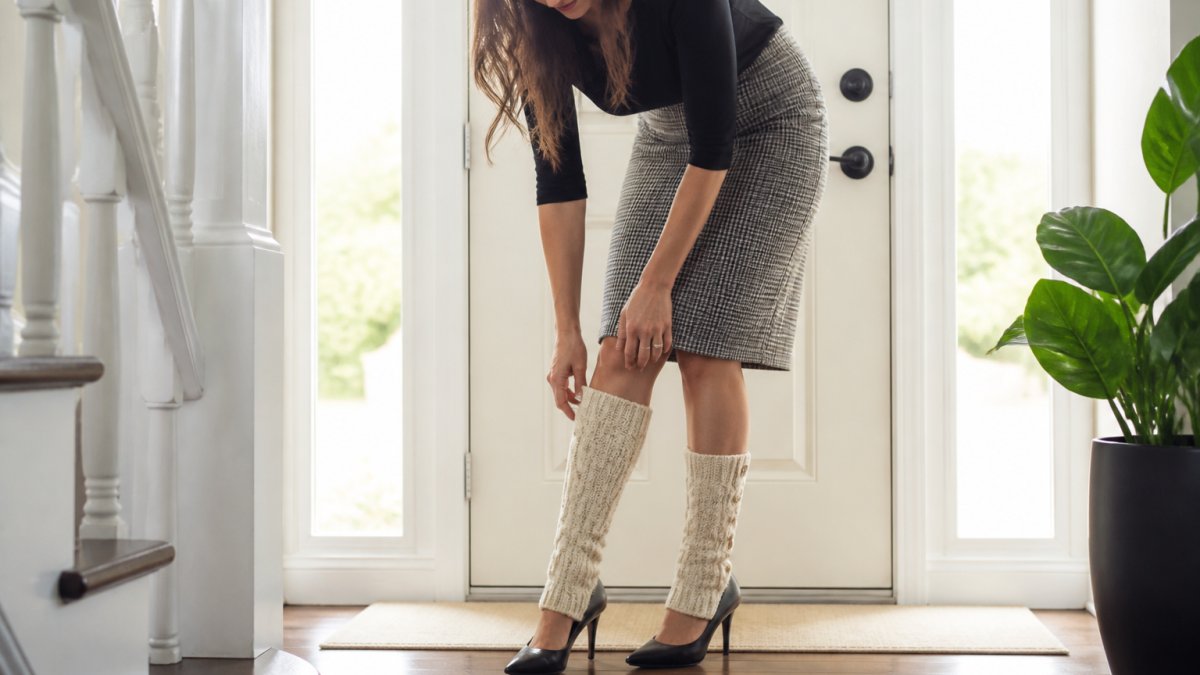
Outfits with boot toppers and pumps come down to one rule: keep the lines clean. The topper is already a texture statement, so let the rest of the outfit stay simple. The second rule is hem math. A skirt or dress hem should clear the top edge of the topper by at least 3 inches, or overlap it by at least 4 inches.
Occasion Formulas: Work, Weekend, Evening
- Work: Straight-leg or wide-leg trousers hemmed to the ankle bone, a fine-gauge topper in a neutral tone (charcoal, camel, navy), and a low block heel. The trouser hem should break just above the topper's top edge so the knit shows as a deliberate layer, not a gap.
- Weekend: Skinny jeans tucked into a chunky cable-knit topper with a flat or low pump. Cuff the jeans once above the topper if the denim is stiff; a single fold keeps the fabric from bunching at the knee.
- Evening: A midi skirt in satin, silk, or ponte, a sleek vinyl or faux leather sleeve, and a pointed stiletto. Match the topper's finish to the shoe's finish: matte knit with matte leather, sheen with sheen. Mixing a high-shine sleeve with a matte pump reads as an accident, not a choice.
Skirts, Dresses, and Trousers: What Actually Works
- Midi skirt (24-28 inch hem): Best with a knee-high topper. The hem should land 3-5 inches below the topper's top edge so the knit reads as a continuous line into the skirt.
- Knee-length A-line: Best with a mid-calf topper. The flare of the skirt balances the volume of the knit.
- Pencil skirt: Best with a fine-gauge topper. A chunky cable knit under a pencil skirt creates a lumpy line at the hip.
- Wide-leg trousers: Best with an ankle-length topper. The topper fills the space between the hem and the shoe without adding bulk to the leg.
- Skinny jeans: The easiest pairing because the denim slides inside the topper without bunching. Tuck the jeans into the topper, not over it.
Color and Texture Pairings That Hold Up
A topper in the same color family as your pump elongates the leg. A topper in a contrasting color draws the eye to the ankle, which works best on tall frames or with a short hem. For texture, pair a smooth pump (patent, polished leather) with a textured topper (cable, rib, seed stitch), and a textured pump (suede, woven leather) with a smooth topper (fine merino, bamboo). Two textures competing at the same scale look busy.
How to Keep Boot Toppers From Slipping
Slipping is the number one complaint about knitted toppers, and it usually traces back to fit rather than the fabric itself. A sleeve that matches your calf measurement grips on its own. A loose one will slide no matter what you do.
- Match the measurement, not the shoe size. Measure the widest part of your calf and the point where the topper will end.
- Look for a wide elastic band at the top edge rather than a thin one.
- Try a silicone grip strip inside the cuff if the sleeve still creeps.
- Avoid slick hosiery under the sleeve. Bare legs or cotton tights hold better.
- Pull it up slightly higher than needed, then let it settle as you walk.
If a topper bunches at the ankle instead of sliding down, it is too long for your leg. Fold the cuff once to shorten it.
Matching Knitted Boot Toppers to Pump Styles
Not every topper suits every pump. The shoe shape underneath changes how the sleeve sits, so match the two before you commit to a look.
| Pump Style | Best Topper | Why It Works |
|---|---|---|
| Pointed stiletto | Fine knit, thin cuff | Keeps the sharp toe line visible |
| Block heel | Chunky cable knit | Balances the heavier sole |
| Rounded toe | Ribbed mid-weight knit | Smooths over the curve |
| Ankle strap | Stretch faux leather | Sits flush over the strap |
| Kitten heel | Soft, light knit | Does not overwhelm the low heel |
The thinnest stilettos are the hardest to cover. A fine-gauge knit with a narrow cuff works best because it hugs the shoe instead of ballooning over it. Chunky block heels can carry a heavier cable knit without looking bottom-heavy.
Seasonal Styling: Warmth Without Bulky Socks
Knitted toppers give you warmth without bulky socks, which is the whole point for most people. A thick sock adds volume inside the shoe and can make a snug pump uncomfortable by mid-morning. A topper adds warmth on the outside of the leg, where it does not crowd your toes. That distinction matters most in the seasons when you are moving between heated interiors and cold streets.
Fall and Spring: Transitional Weight
A fine-gauge cotton, bamboo, or merino topper in the 4-6 inch range above the shoe works best when temperatures swing 20 degrees between morning and afternoon. Pair it with bare legs or a thin cotton tight. A pointed pump in smooth leather or suede reads cleanest here because the shoe's line stays visible under a light knit.
Winter: Layering Without Crowding the Shoe
For cold-weather wear, choose a wool-blend or acrylic knit with a tight gauge and a wide elastic band at the top. The topper should sit over a cotton or fleece-lined tight, not over a thick wool sock, the sock adds volume inside the pump, the tight does not.
A common pattern is to wear a knee-high topper with a midi skirt and a block-heel pump in winter. The block heel handles ice and wet pavement better than a stiletto, and the wider heel balances the visual weight of a heavier knit.
Indoor and Outdoor Transitions
The biggest seasonal problem with toppers and pumps is not the cold, it is the heat. A wool topper that feels right on the street becomes uncomfortable after 20 minutes in a heated office. Two solutions work:
- Choose a topper you can fold down. A mid-calf topper folds to ankle length and reads as a slouchy cuff indoors.
- Keep a second, lighter topper at your desk. Swap the wool for a cotton or bamboo version when you arrive.
Pump Materials by Season
- Patent leather: Best in fall and winter. Wipes clean of salt and slush, but does not breathe, pair with a cotton tight, not a fleece-lined one.
- Suede: Best in dry fall and spring. Avoid in snow or rain; salt stains are difficult to remove.
- Smooth leather: Works year-round. The most forgiving material for a topper that sits over the shoe opening.
- Fabric or mesh pumps: Best in spring and summer. A topper over a mesh pump can snag the shoe, so keep the knit fine and the cuff narrow.
Conclusion: Your Next Pair of Pumps Just Got More Wear
The hardest part of cold-weather dressing is the gap between a great pair of heels and a warm leg.
Bootsy- The Boot Sleeve was built for exactly this. Our patent-pending design is sized by thigh and calf measurements from 14" to 60", not shoe size, and the stretch faux leather and vinyl sleeves turn the heels you already own into boots.
Get started with Bootsy- The Boot Sleeve and wear the pumps you love all season long.
Frequently Asked Questions
Can you wear knitted boot toppers with pumps?
Yes. Knitted boot toppers are designed to sit over the shoe opening and cover the ankle and calf, so they work with pumps as long as the topper's lower edge grips the shoe securely. Pointed and almond-toe pumps with a defined heel counter hold the cuff best. Avoid pumps with slick, rounded uppers and no heel structure, since the topper has nothing to anchor against and will slide as you walk.
How do you keep boot toppers from slipping down?
Stretch the cuff band so it sits snug against the narrowest part of your ankle, not the widest part of your calf. If the topper still creeps, fold the bottom edge under once to create friction against the shoe, or add a thin silicone strip inside the cuff.
What outfits look good with knitted boot toppers and heels?
Skinny jeans tucked into the topper create a clean line from knee to shoe. A-line skirts and sweater dresses work when the topper ends at or just below the knee, so the knit reads as part of the boot rather than a separate layer. For evening, pair a mid-calf topper with a slip dress and a block heel. The knit adds texture against the smooth fabric without competing with the shoe.
How do you make pumps look like boots with boot sleeves?
Pull the sleeve over the pump so the bottom edge sits flush against the shoe's opening and the top reaches your target height, whether that is mid-calf or above the knee. Smooth the fabric from ankle to top so no wrinkles bunch at the bend. A sleeve sized by calf measurement, not shoe size, gives the closest match and keeps the line straight from shoe to shaft.
0 comments