

Table of Contents
- How to Measure Calf Circumference: A Step-by-Step Guide
- How to Measure Your Calf for Tall Boots vs. Ankle Boots
- Wide Calf vs. Standard Calf Boots: Knowing the Difference
- Finding Comfortable Boots for Wide Calves After You Measure
-
Measuring for Different Boot Materials and Styles
- Leather: Minimal Stretch, Maximum Break-In
- Suede and Nubuck: Essentially Zero Give
- Stretch Fabrics and Knit Materials: Forgiving but Compressible
- The Elastic Gusset: A Game-Changing Feature
- Boot Height Changes Where You Measure
- A Practical Measurement Protocol by Material
- When to Consider a Boot Sleeve Instead
- Troubleshooting Fit Issues: Common Mistakes to Avoid
- Conclusion: Use Your Measurements for a Perfect Fit
- Frequently Asked Questions
Last Updated: September 5, 2026
Finding boots that fit well is about more than shoe size. The shaft of a boot must accommodate your calf circumference, and if it doesn't, the boot won't zip, buckle, or sit comfortably. Measuring your calf for boots is a simple process that takes under five minutes and requires only a flexible tape measure, yet most guides skip the nuance that separates a snug fit from a painful one. At Bootsy- The Boot Sleeve, we design size-inclusive footwear accessories, so we understand exactly where standard sizing fails and how precise measurements solve it.
Below, we'll walk through the correct technique, explain the difference between wide calf and standard calf sizing, and show you how to troubleshoot common fit issues before they ruin a purchase.
How to Measure Calf Circumference: A Step-by-Step Guide
Measuring your calf circumference is the core of the process. The most accurate measurement is taken in a standing position with your weight evenly distributed, because your calf muscle relaxes and changes shape when you sit. Follow these steps in order for a reliable number you can trust.
What You'll Need
Gather these items before you start to ensure measurement accuracy:
- A flexible tape measure (cloth or vinyl, not a metal builder's tape). A fabric tape at least 60 inches long is ideal.
- A chair or flat surface to sit on, in case you need to rest or re-check a measurement.
- The socks or hosiery you plan to wear with the boots. This is non-negotiable for an accurate fit.
- A pen and paper, or a notes app on your phone, to record your numbers immediately.
Step 1: Find the Widest Part of Your Calf
Stand with your feet shoulder-width apart and your weight evenly distributed on both legs. Identify the most muscular, fullest part of your lower leg, typically about halfway between your knee and ankle, but it varies by individual. Do not guess, flex your calf muscle slightly to feel where the muscle belly is largest, then relax.
Step 2: Position the Tape Measure Correctly
Wrap the tape measure around this fullest part of your calf. The tape must be held parallel to the floor, a tilted tape will add or subtract inches and give you a false reading. Keep the tape snug against your skin or sock, but do not pull it tight enough to compress the tissue. A good check: you should be able to slip one finger comfortably between the tape and your leg. If you cannot, it is too tight; if you can slip two fingers, it is too loose.
Step 3: Read and Record the Measurement
Look straight down at the point where the tape overlaps. Read the number at the overlap point, keeping your eye level with the tape to avoid parallax error. Record this number immediately. Do not rely on memory, even a few minutes later, you may second-guess the exact figure.
Step 4: Repeat for Accuracy
Take the measurement two more times, repositioning the tape each time. Use the largest of the three numbers as your official calf circumference, since muscle volume can fluctuate throughout the day and a boot that fits in the morning may feel tight by evening.
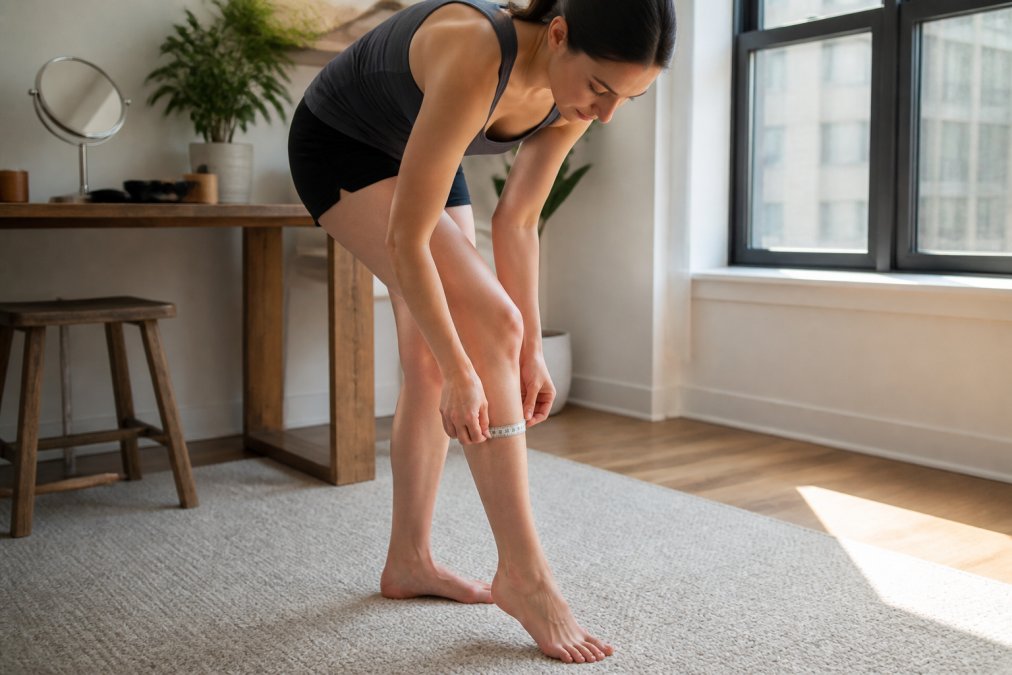
Step 5: Measure Both Legs
Many people assume their calves are identical, but asymmetry of up to half an inch is common. Measure both legs using the same process. If you find a difference, order for the larger leg. Boots can accommodate a slightly smaller calf with an insole or a thicker sock, but they cannot be stretched to fit a larger one.
Visual Reference Points for Self-Measurement
Without a second person to help, use a full-length mirror to confirm the tape forms a straight, horizontal line around your leg. If measuring alone, place a small sticker on your skin at the widest point first, then wrap the tape directly over that mark to prevent drifting.
How to Measure Your Calf for Tall Boots vs. Ankle Boots
The height of the boot shaft determines where you need to measure. For ankle boots, the shaft typically ends below the fullest part of your calf, so fitting is more about the boot opening around your ankle. For knee-high and tall boots, the widest part of your calf must fit through the entire boot opening.
For tall boots, measure at the fullest part of your calf and again two inches below the crease behind your knee, since shafts often taper or flare. Many sizing charts list the circumference at the top of the shaft rather than at the widest point, a common source of confusion.
Wide Calf vs. Standard Calf Boots: Knowing the Difference
Standard calf boots typically accommodate a circumference of about 14 to 16 inches, while wide calf boots generally start around 17 inches (vionicshoes.com). There is no universal standard across brands, so a "wide calf" label from one manufacturer might match a "standard" size from another, knowing your exact measurement matters more than the label.
If your measurement falls between sizes, sizing up in shoe size does not reliably increase the shaft circumference, it often only adds length to the foot, leaving you with a boot that is loose in the heel but still tight in the calf.
Finding Comfortable Boots for Wide Calves After You Measure
Once you have your measurements, look for boots that list the calf circumference in the product specifications rather than describing the fit with vague terms. If a brand does not provide this number, contact customer service before ordering.
When your measurement exceeds what traditional boot shafts offer, consider boot sleeves, stretchable fabric or faux leather tubes that cover your lower leg and pair with your existing heels to create the look of a boot. Bootsy- The Boot Sleeve designs these with an inclusive fit, sized by calf and thigh measurements rather than shoe size, accommodating leg circumferences from 14 to 60 inches.
Measuring for Different Boot Materials and Styles
The material of the boot changes how much give you can expect, and understanding this before you measure can save you from a costly return.
Leather: Minimal Stretch, Maximum Break-In
Full-grain and top-grain leather boots stretch slightly with wear, but the process is slow, uneven, and never guaranteed, the shaft circumference often changes very little (hss.edu). For rigid leathers, add half an inch of breathing room to your calf measurement to account for sock thickness and muscle expansion. If your measurement is 16.5 inches, look for a leather boot listed at 17 inches or more.
Suede and Nubuck: Essentially Zero Give
Suede and nubuck have almost no structural stretch, and forcing a tight shaft can permanently distort the material or crack the finish. Your measurement must be at least a quarter inch under the listed shaft circumference, if between sizes, size up rather than hoping the suede will relax.
Stretch Fabrics and Knit Materials: Forgiving but Compressible
Boots with elastic panels, knit uppers, or stretch fabric shafts typically offer 1 to 2 inches of give beyond their resting circumference, but they compress over time as elastic fibers fatigue (peer-reviewed research). For stretch materials, your exact measurement is sufficient, do not add extra room. If between sizes, choose the smaller option since the fabric will conform to your leg.
The Elastic Gusset: A Game-Changing Feature
Look for boots with an elastic gusset, a stretchy panel sewn into the shaft, often near the zipper or side seam. This feature can add up to 2 inches of flexibility to the boot opening, allowing the effective opening to exceed the listed number. If a boot you love is half an inch short of your measurement, check for a gusset before ruling it out.
Boot Height Changes Where You Measure
Beyond material, the style of the boot determines how many measurement points you need. For ankle boots, the boot opening circumference around your ankle is the relevant number. For knee-high and tall boots, the widest part of your calf must fit through the entire boot opening. For over-the-knee boots, also measure your thigh at the point where the boot shaft ends, since that often becomes the limiting factor.
A Practical Measurement Protocol by Material
Before you order, write down three numbers: your bare calf measurement, your calf measurement with the socks you plan to wear, and the boot's listed shaft circumference. Then apply this simple rule:
- Rigid materials (leather, suede, synthetic leather): Boot shaft must be at least 0.5 inches larger than your socked measurement.
- Semi-stretch materials (elastic gussets, paneled shafts): Boot shaft can match your socked measurement, provided the stretch panel is positioned at the widest part of the calf.
- Full-stretch materials (knit, stretch fabric): Boot shaft can be up to 1 inch smaller than your socked measurement, as the material will expand.
When to Consider a Boot Sleeve Instead
If your measurement exceeds what traditional boot shafts offer, or if you prefer the look of a tall boot without the struggle of finding one that fits, a boot sleeve is a practical alternative. Boot sleeves bypass the material constraints of traditional boots entirely because they are designed to stretch around your leg rather than hold a rigid shape. Bootsy- The Boot Sleeve sizes its products by calf and thigh measurements rather than shoe size, accommodating leg circumferences from 14 to 60 inches.
Troubleshooting Fit Issues: Common Mistakes to Avoid
The most frequent mistake is measuring while sitting down, which shortens the calf muscle and produces a smaller number. Always measure standing with your weight on both feet.
Another mistake is ignoring your socks. Measure while wearing the socks you intend to wear with the boots. If you plan to wear different sock thicknesses across seasons, measure with your thickest pair to ensure the boots work year-round.
Conclusion: Use Your Measurements for a Perfect Fit
Measuring your calf for boots removes the guesswork from shopping. You now know how to find the widest part of your calf, why standing position matters, and how boot materials affect the fit.
If your measurements fall outside the range of traditional wide calf boots, Bootsy- The Boot Sleeve offers a patent-pending design that transforms your existing heels into mid-calf or thigh-high boots, sized by your actual leg measurements rather than a generic shoe size. The stretch faux leather and vinyl materials accommodate many body types while creating versatile looks from shoes you already own.

Get started with Bootsy- The Boot Sleeve and turn your measurements into a boot collection that fits every time.
Frequently Asked Questions
Is a 16 inch calf wide?
A 16-inch calf measurement is often considered the starting point for wide calf boots. Standard calf boots typically fit up to 15 or 15.5 inches. If your measurement is 16 inches or more, look for styles labeled wide calf or consider size-inclusive options like boot sleeves that accommodate measurements up to 60 inches.
How should boots fit around the calf?
Boots should fit snugly around your calf without being tight or restrictive. You should be able to slide one finger between your leg and the boot shaft. For zipped boots, the zipper should close without pulling or gaping. Remember that some materials, like stretch faux leather, offer more give than rigid leather.
What should I do if my calf measurement falls between sizes?
If your calf measurement falls between standard boot sizes, size up for comfort. A boot that is too tight will be unwearable, while a slightly larger shaft can be adjusted with inserts or by wearing thicker socks. Alternatively, look for boots with adjustable features like laces, elastic gussets, or stretch materials that accommodate a range of measurements.
Should I measure my calves standing or sitting?
Measure your calf while standing with your weight evenly distributed on both legs. This is the most accurate position as your calf muscle relaxes and changes shape when you sit. You should also measure while standing, as your calf muscle can expand slightly. Use the larger of the two measurements for the most comfortable fit.
Finding well-fitting boots is a challenge for many women, especially those with wider calves. Precise measurements are the first step, but when standard shafts fall short, Bootsy- The Boot Sleeve provides a size-inclusive alternative that works with your existing heels.
This article was written using GrandRanker
0 comments