

Table of Contents
- Tools You'll Need to Measure Thighs for Boots
- How to Measure Thigh Circumference Accurately
- How to Measure Calf Circumference for Wide Calf Boot Solutions
- Measuring Boot Height and Shaft Fit
- Comfortable Boots for Wide Calves: Using Your Measurements
- Common Mistakes When Measuring and How to Avoid Them
- Troubleshooting Fit Issues After You Measure
- Conclusion
Last Updated: August 28, 2026
Tools You'll Need to Measure Thighs for Boots
Measuring accurately requires just a few basic items you likely already have at home. A flexible measuring tape is essential, the kind used for sewing or tailoring works best because it conforms to your leg's contours without gaps. Avoid rigid rulers or metal tape measures, which won't give you a true circumference reading.
Beyond the tape measure, wear the socks you plan to wear with your boots when you measure. This matters more than most guides acknowledge. Thick wool socks or compression socks add real volume to your leg, and skipping this step means your measurements won't match your actual boot-wearing reality. A mirror helps too, though it's optional if you're measuring yourself carefully by feel.
Some people find it helpful to mark measurement points with a washable pen or tape before wrapping the measuring tape. This prevents the tape from slipping and ensures consistency if you need to remeasure. A notepad or phone notes app keeps your measurements organized so you can reference them later when comparing sizing charts or evaluating boot options like Bootsy's boot sleeves, which are sized by thigh and calf measurements rather than shoe size.
Finally, take your time. Rushing through measurements is where most errors happen. Set aside five minutes in a comfortable position where you can focus on getting accurate readings.
How to Measure Thigh Circumference Accurately
The thigh measurement is the starting point for finding comfortable boots that actually fit your leg. Thigh circumference determines whether a boot will sit properly without gaps or pinching, making this measurement critical for any boot purchase or accessory like a boot sleeve.
Finding the Right Measurement Point
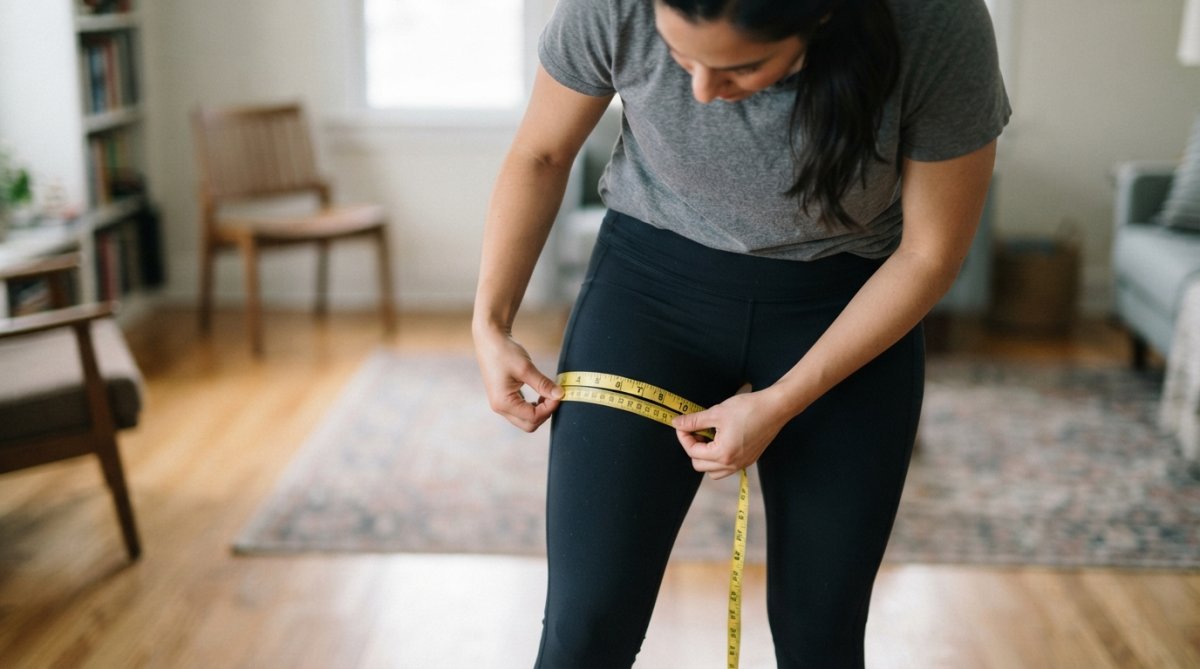
Your thigh is widest at different points depending on your body shape. For most people, the fullest part of the thigh sits about 4-6 inches below the groin crease, roughly halfway between your hip and knee (peer-reviewed research). This is where you should take your primary thigh measurement.
To locate this point, stand in front of a mirror and run your hand down your thigh. Feel where the muscle is most prominent. That's your measurement zone. Mark it lightly with a pen if it helps you stay consistent. Some people have very full thighs higher up near the hip, while others carry more volume lower. Find YOUR widest point, not what a chart tells you it should be.
Wrap the measuring tape around your thigh at this point. Keep the tape parallel to the ground, not angled. The tape should be snug enough to register your true circumference but not so tight it compresses your skin. This balance matters. A tape that's too loose gives you an inflated measurement; one that's too tight gives you a number your actual leg can't achieve.
Sitting vs. Standing: Which Matters More
This distinction catches many people off guard. Your thigh circumference changes when you sit versus stand. When seated, your thigh flattens and spreads slightly, often increasing in apparent circumference by half an inch to an inch (peer-reviewed research). When standing, the muscle is more compressed and the measurement is tighter.
For boot purposes, standing measurement is the standard. Boots are worn while you're moving, walking, and standing most of the time. That's the measurement that matters. However, if you plan to wear boots while sitting frequently, during long flights, office work, or driving, take both measurements and use the larger one. This gives you a safety margin so the boot won't feel restrictive when you're stationary.
Most boot sizing charts use standing measurements as their baseline. When you compare your measurements to sizing options, make sure you've taken the standing measurement. This is where Bootsy's approach differs from traditional boots: because Bootsy's boot sleeves are sized by actual thigh and calf circumference rather than height-based shoe size, you get a fit that works whether you're standing or sitting, as long as you measure accurately in the position where you'll wear the boots most.
How to Measure Calf Circumference for Wide Calf Boot Solutions
Your calf measurement is equally important as your thigh measurement for boots that fit properly. The calf determines whether a boot shaft will feel comfortable or restrict circulation, and it's especially critical if you have wide calves that don't fit standard boot sizing.
Locating Your Widest Calf Point
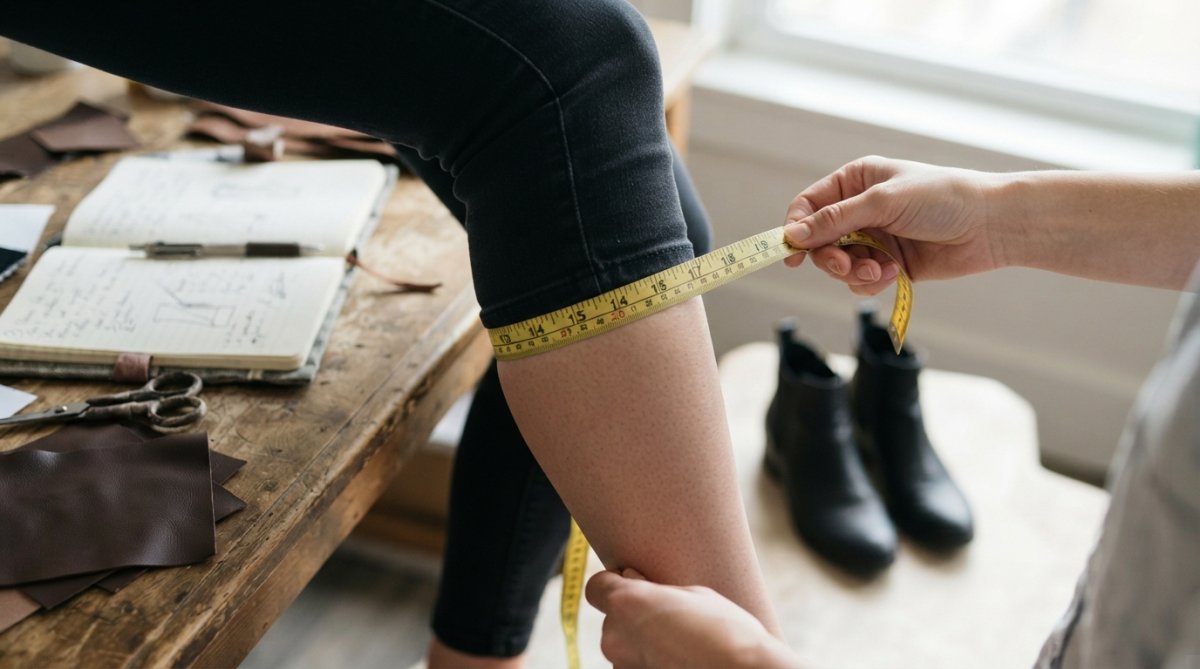
Your calf is widest at the belly of the muscle, typically about one-third of the way down from your knee to your ankle. This is usually 5-7 inches below your knee, but again, your anatomy might be different (peer-reviewed research).
Stand with your feet together and flex your calf muscle slightly by rising onto your toes. Feel where the muscle bulges most. That's your measurement point. Some people have very muscular calves that peak high, while others carry more width lower. Find the exact spot where your calf is fullest.
Wrap the measuring tape around this widest point, keeping it parallel to the ground. Use the same snug-but-not-compressing tension you used for your thigh. This measurement determines whether a boot will zip comfortably or leave you frustrated with a gap at the back of your leg.
Accounting for Sock Thickness
Sock thickness affects your calf measurement just as much as your thigh measurement. Measure your calf while wearing the socks you'll actually wear in the boots. Thin dress socks add minimal volume, but compression socks or wool hiking socks can add a quarter inch or more to your circumference.
If you wear different sock thicknesses depending on the season or occasion, measure with both. Take a thin-sock measurement and a thick-sock measurement. When you're shopping for boots or boot sleeves, you'll know your range and can choose something that accommodates your typical sock weight.
Measuring Boot Height and Shaft Fit
Boot height determines how much of your leg the boot covers. This measurement runs from the heel of your shoe to the top opening of the boot. For thigh-high boots, this extends well above the knee. For mid-calf boots, it stops around the widest part of your calf. For ankle boots, it covers just the ankle area.
Measure from the bottom of your heel to the point where you want the boot to end on your leg. Stand while you do this, as your leg length and proportions are different when seated. If you're measuring for thigh-high boots, measure from your heel all the way to mid-thigh, typically 22-26 inches depending on your leg length.
The shaft measurement is slightly different. This refers to the circumference of the boot opening at the top. A boot with a 15-inch shaft opening will fit differently than one with a 20-inch opening, even if both are the same height. If you're using a product like Bootsy's boot sleeves, which are designed to transform your favorite heels into boots, the shaft fit is already engineered into the sleeve design based on your thigh and calf measurements.
Comfortable Boots for Wide Calves: Using Your Measurements
Once you have your thigh, calf, and height measurements, you can evaluate whether boots will actually work for you. This is where many people struggle, they have measurements but don't know how to use them effectively.
Comparing Your Measurements to Sizing Charts
Most boot brands provide sizing charts that list thigh and calf circumference ranges. Compare your measurements directly to these ranges. If your thigh is 18 inches and the chart lists sizes for 16-19 inches, you're in that size range. If your calf is 15.5 inches and the chart jumps from 14-15 inches to 16-17 inches, you're between sizes, and that's a red flag for fit issues.
Standard boot sizing often assumes proportional legs. If you have a 20-inch thigh but only a 13-inch calf, traditional boots designed for average proportions won't fit you well. This is where boot sleeves offer an advantage: Bootsy's sleeves are sized independently for thigh and calf, so you can match your actual measurements without compromise.
Accounting for Different Boot Materials and Stretch
Boot material affects how your measurements translate to actual fit. Leather boots stretch over time and with wear, typically expanding a quarter inch to half an inch in circumference. Faux leather and vinyl materials have less stretch, usually a quarter inch or less. Knit or fabric boots offer the most stretch, sometimes up to an inch.
When you're evaluating boots, factor in the material's stretch potential. If a leather boot measures 16 inches in the calf and you have a 15.5-inch calf, it might work because leather will soften and stretch slightly. If a rigid faux leather boot measures 16 inches and you have a 15.5-inch calf, it will likely feel tight and restrictive.
Bootsy's boot sleeves use high-quality stretch faux leather and vinyl specifically engineered to accommodate measurements from 14 inches to 60 inches in circumference. The stretch is built into the material so you get a comfortable fit without the guesswork of predicting how much a material will relax over time.

Common Mistakes When Measuring and How to Avoid Them
Most measurement errors fall into predictable categories. Recognizing these mistakes now prevents wasted time and frustration later.
The biggest mistake is measuring over clothing. Even a thin pair of leggings adds thickness that throws off your measurements. Always measure directly against your skin or with the exact socks you'll wear in the boots. This is non-negotiable for accuracy.
Another common error is measuring at the wrong anatomical point. People measure their thigh too low (closer to the knee) or too high (closer to the hip), getting a measurement that doesn't represent their actual fullest point. This creates a mismatch between your measurements and how boots actually fit. Spend time finding your true widest point.
Inconsistent tape tension is another culprit. If you wrap the tape loosely one time and snugly the next, you'll get different readings. Decide on your tension level and stick with it. Snug enough to register your true circumference without creating an indent in your skin is the standard.
Some people measure only once and assume that's accurate. Measure twice. If your two measurements differ by more than a quarter inch, measure a third time. Consistency matters. Take the average of your measurements if they vary slightly.
Finally, people often ignore the sitting-versus-standing question. If you'll wear boots primarily while sitting (office work, travel), measure sitting. If you'll wear them standing and walking, measure standing. The difference is real and affects fit.
Troubleshooting Fit Issues After You Measure
Even with accurate measurements, fit problems can still occur. Understanding why helps you find solutions.
If a boot feels loose around your calf but tight around your thigh, you likely have a proportional mismatch. Your thigh is significantly larger than your calf relative to standard sizing. Traditional boots won't solve this, you need a solution that sizes independently for each area. Bootsy's boot sleeves address this exact problem by letting you choose your thigh size and calf size separately.
If a boot feels tight everywhere, you might have measured with thin socks but plan to wear thick socks. Remeasure with the socks you'll actually wear. Alternatively, the boot material might have minimal stretch. Check the material composition and expected stretch before purchasing.
If a boot feels loose everywhere, you might have measured too loosely. Remeasure with proper tension. Or the boot might be designed for a different body proportion than yours. This is common when you have shorter legs relative to thigh width, or longer legs relative to calf width.
Gapping at the back of the boot shaft is usually a calf measurement issue. Either you measured incorrectly, or the boot isn't designed for your calf width. If your measurement was accurate, the boot simply isn't the right fit for your body.
If you're between sizes on a sizing chart, choose the larger size. A boot that's slightly loose can be adjusted with thicker socks or inserts. A boot that's too tight will never be comfortable and can restrict circulation.
Getting your measurements right is the foundation for finding boots that actually fit your body. Too many people skip this step or rush through it, then blame themselves when boots don't work. The issue isn't your body, it's that standard sizing doesn't account for the full range of human leg proportions.
At Bootsy- The Boot Sleeve, we've built our entire sizing system around actual thigh and calf measurements because we know one-size-fits-most doesn't work. Our boot sleeves transform your favorite heels into stylish boots by sizing based on your specific leg circumference, not shoe size. Whether you have a 16-inch thigh or a 28-inch thigh, you'll find a size that fits. This approach eliminates the frustration of standard boots that gap, pinch, or simply don't exist in your size. Measure carefully, compare to our sizing chart, and discover how boots can finally work for your body. Add Bootsy to your shoe collection and experience the difference accurate, inclusive sizing makes.
Frequently Asked Questions
Q: How is thigh size measured for boots?
A: Thigh size is measured by wrapping a measuring tape horizontally around the fullest part of your thigh. Keep the tape snug but not tight, you should be able to slide one finger underneath. Measure while standing with your feet hip-width apart and your weight distributed evenly. Record the measurement in inches. This circumference measurement, rather than height, is what determines whether a boot will fit your leg properly, especially important for thigh-high styles.
Q: What tools do I need to measure my legs for custom-fit boots?
A: You need a flexible measuring tape (fabric or soft plastic works best), a mirror or second person to help ensure accuracy, and a notepad to record your measurements. Wear the socks or hosiery you plan to wear with your boots, as sock thickness affects the final measurement. Avoid using rigid rulers or metal measuring tapes, as they don't conform to your leg's shape and give inaccurate readings.
Q: How do I account for clothing when measuring my thighs for boots?
A: Measure while wearing the same type and thickness of clothing or hosiery you'll wear with your boots. If you plan to wear tights, wear them during measurement. If you prefer bare legs or thin socks, measure that way instead. This accounts for fit tolerance and ensures the boot sleeve or boot shaft sits properly. The stretch fabric in quality boot options accommodates slight variations, but starting with accurate measurements specific to your typical boot outfit prevents slipping and bunching throughout the day.
Q: Should I measure sitting or standing for the most accurate thigh measurement?
A: Measure both sitting and standing, then use the larger measurement. When you sit, your thigh expands slightly due to compression against the chair. Since you'll wear boots while moving and sitting throughout your day, the standing measurement is typically your primary reference. However, if you sit for extended periods (desk work, travel), checking your sitting measurement ensures comfort in both positions. Record both numbers and match them against sizing charts that account for different activities and fit tolerance.
This article was written using GrandRanker
0 comments