

Last Updated: October 25, 2026
Quick Summary
The best wide calf boot socks are thin, fine-gauge styles with wide non-binding cuffs that match your measured calf circumference, so they stay up without adding pressure under a snug shaft. Measure your calf standing and check the gap to your boot shaft before choosing sock thickness.
- Sock height should clear the top of the boot shaft by about an inch to stop the cuff sliding down.
- Aim for a cuff that sits snug with roughly one to two inches of give around your calf.
- Less than half an inch of gap between calf and shaft calls for a thin, fine-gauge sock.
- Skip cotton for anything longer than a short errand because it holds moisture and worsens friction.
- Do not size down for a tighter cuff; a smaller sock digs in and rolls at the top.
Table of Contents
- Start With the Boot Shaft, Not the Sock Aisle
- Best Socks for Tall Boots: Height and Coverage Rules
- Socks That Stay Up in Boots Without Squeezing Your Calf
- Thin Socks for Boots: When Less Fabric Means More Room
- Socks to Prevent Blisters in Boots: Fabric, Seams, and Fit
- How to Measure Your Calf Before You Buy Socks
- Matching Socks to Boot Styles and Outfits
- Pairing the Right Socks With a Boot Sleeve
- Frequently Asked Questions
Start With the Boot Shaft, Not the Sock Aisle
The best wide calf boot socks solve a fit problem, not a fashion problem.
Most shoppers head straight for the sock wall and buy the thickest, coziest pair they can find. That is backwards.
If the shaft is snug, thin socks buy you room. If the shaft gapes, cushioning fills the space and stops friction.
That logic applies to socks too. Before you browse the sock aisle, browse wide calf boots that match your actual shaft measurement.
Best Socks for Tall Boots: Height and Coverage Rules
Sock height should clear the top of the boot shaft by about an inch to prevent the cuff from sliding down inside the boot.
Here is how height maps to boot style:
| Boot Style | Shaft Height | Sock Height | Why |
|---|---|---|---|
| Ankle boots | Below ankle | No-show or ankle | Prevents peek-above-cuff gaps |
| Mid-calf boots | Mid-calf | Mid-calf socks | Covers the shaft top cleanly |
| Knee-high boots | At or below knee | Over-the-calf socks | Stops cuff roll and rubbing |
| Tall boots | Above knee | Over-the-calf or thigh-high | Full coverage under the shaft |
The best wide calf boot socks for tall boots are over-the-calf styles that stay put without a tight band.
A sock that stops exactly at the shaft edge will roll down within an hour of walking. Give yourself that extra inch of fabric.
Socks That Stay Up in Boots Without Squeezing Your Calf
Staying power comes from cuff construction, not cuff tightness. A wide, non-binding cuff grips through surface contact and gentle stretch rather than clamping down. When the boot shaft is already close to your calf, a tight sock band does not add grip, it adds pressure you feel within an hour of walking.
Look for these features when you shop for socks that stay up in boots:
- A wide cuff band, ideally an inch or more deep
- Graduated stretch that is firm at the top and relaxed below
- A silicone grip strip inside the cuff on dress and fashion socks
Why a tight cuff fails under a wide boot shaft
A sock stays up because the cuff's contact area and elastic recovery hold it against the leg. A narrow, highly elastic band concentrates force on a thin ring of skin.
A wider band spreads the same holding force over more surface area. That is why a soft, one-inch cuff sized to your calf circumference often holds better than a narrow, tight band, the wide-calf fit problem is a construction problem before it is a sizing problem.
Match cuff circumference to calf measurement
A sock labeled "wide calf" is only useful if its relaxed cuff circumference is close to your measured calf. A cuff that has to stretch several inches will squeeze all day; one loose enough to slide will bunch inside the shaft.
Measure your calf at its widest point while standing, then compare it to the sock's stated cuff circumference. If none is listed, treat the size label as a starting point only.
Low-bulk cuffs under a fitted shaft
When the boot shaft is snug, the sock cuff is the layer most likely to create a visible ridge or pressure line. A low-bulk cuff, flat or minimally turned rather than thick and folded, keeps the profile smooth.
Compression socks are a different product with a different job: true compression applies measured pressure for circulation support and requires a proper fit. Do not treat a tight sock as a compression sock.
If slipping sleeves are your bigger frustration, the same principles apply. Read Do Boot Sleeves Stay Up to see what keeps them in place.
Thin Socks for Boots: When Less Fabric Means More Room
Thin socks are the fix when a boot shaft fits but leaves no room for a thick sock. Reducing fabric thickness frees up space around the calf and reduces pressure under a fitted shaft.
The best thin socks for boots share three traits:
- Fine-gauge knit. A smooth, low-profile weave that adds minimal bulk.
- Moisture-wicking fiber. Merino wool in a lightweight weave or a synthetic blend moves sweat away instead of trapping it.
- Flat, smooth seams. Toe seams that sit flat prevent hot spots on long walks.
Thin does not mean flimsy. A lightweight merino sock regulates temperature better than thick cotton and dries faster after a sweaty day; synthetic blends dry quickly and hold up well in work and hiking boots.
Where thin socks fall short: they offer little cushioning, so they suit dress boots, Chelsea boots, and snug shafts.
Socks to Prevent Blisters in Boots: Fabric, Seams, and Fit
Blister prevention comes down to three things: moisture control, seam placement, and a fit that stops the sock from bunching. Friction plus damp skin is what wears a blister into your heel.
Start with fabric. Merino wool and moisture-wicking synthetic blends pull sweat off the skin.
Then check seams. Toe seams should be flat or seamless. A raised seam rubbing against your toes for a mile will find you.
Fit matters most of all. A sock that bunches at the heel or slips down creates the exact friction that causes blisters.
For a deeper walkthrough, loose boots and the wrong sock are a bad pairing, and fixing both at once works better than fixing either alone.
How to Measure Your Calf Before You Buy Socks
Measure your calf at its widest point, usually a few inches below the knee, while standing. Keep the tape snug but not tight, and write the number down.
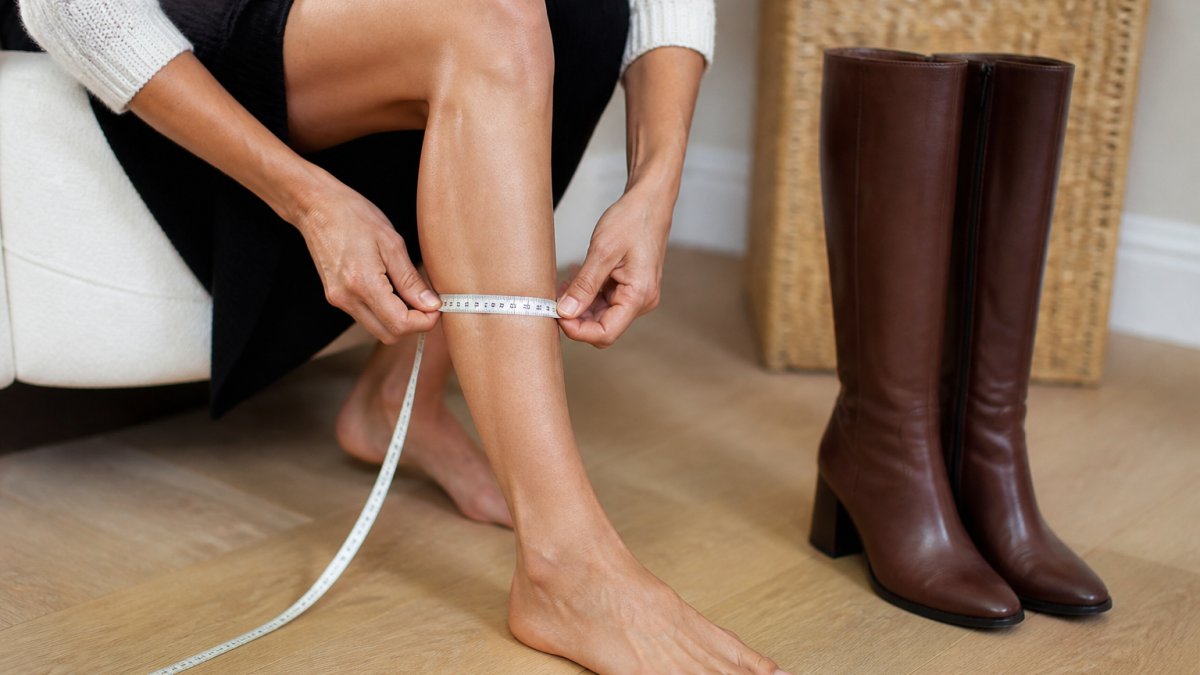
Follow this sequence:
- Stand on a flat floor with your weight evenly balanced.
- Wrap a soft measuring tape around the widest part of your calf.
- Note the circumference in inches.
- Measure the boot shaft opening at the top and at the narrowest point.
- Compare the two: the gap between calf and shaft tells you how much sock thickness you can add.
A common mistake is measuring while seated: your calf spreads when you stand, so a seated measurement runs small and you end up with socks that feel tight by midday. Measure standing, and measure both legs.
Turn the measurement into a sock decision
The gap between your calf and the boot shaft is the number that drives sock thickness. A simple way to use it:
- Less than half an inch of gap: choose a thin, fine-gauge sock. There is no room for cushioning, and a thick sock will make the shaft feel tighter than it did in the store.
- Half an inch to about an inch of gap: a light-to-medium cushioned sock fits without crowding. This is the range where most everyday boot socks work.
- More than an inch of gap: a cushioned or thicker sock fills the space and reduces friction from a loose shaft. Without that fill, the boot slides and rubs.
For the sock itself, compare your calf circumference to the sock's stated cuff circumference. A cuff that needs to stretch more than about two inches to fit over your calf will squeeze; a cuff that is looser than your calf by more than an inch or so will slide. Aim for a cuff that sits snug with modest stretch.
Check stretch and stay-up fit, not just the size label
Sock sizes are often built around shoe size, which tells you nothing about calf fit.
Test stay-up fit by walking a few minutes with the sock on and the boot zipped. The cuff should stay at the same height without rolling or leaving a deep mark. A faint indentation is normal; a red, painful line means the band is too tight.
For a full walkthrough on matching leg measurements to footwear, follow the same steps with fit checks at each stage. The Boot Fit Guide walks through each step.
Matching Socks to Boot Styles and Outfits
Sock choice should follow the boot and the outfit, not the other way around.
- Chelsea boots: Ankle or no-show socks in a color that matches the boot. Clean lines, no peek.
- Chukka boots: Mid-calf socks in a tonal shade, especially with cropped trousers.
- Cowboy boots: Over-the-calf socks with a smooth finish so the shaft slides on easily.
Seasonal layering changes the equation. In cold weather, a lightweight liner under a cushioned wool sock adds warmth without bulk. In summer, a single moisture-wicking layer beats two.
When a patterned sock shows above the boot, match the pattern scale to your outfit. A bold stripe against a busy print competes.
Pairing the Right Socks With a Boot Sleeve
A boot sleeve changes the sock math because it adds a layer over the shoe and ankle.
Our patent-pending boot sleeve turns heels and some flats into boots, sized by calf and thigh measurements from 14 to 60 inches rather than shoe size.
Three rules for pairing socks with a boot sleeve:
- Go thin and smooth. A fine-gauge sock prevents lumps under the sleeve.
- Skip bulky cuffs. A thick sock cuff creates a ridge where the sleeve sits.
- Match sock height to the sleeve length. For a mid-calf look, a mid-calf sock keeps coverage clean.
The styling possibilities are the real payoff.
If you are petite with smaller thighs or plus-size with wider calves, the sleeve is built around your measurement, not a standard size chart.
Frequently Asked Questions
Should socks be thinner or thicker with wide calf boots?
Thin socks usually work better because they take up less space inside a fitted shaft. A thin merino or synthetic blend adds cushioning without pressing your calf against the boot. Save thick socks for boots with extra room or for cold weather when you can size up. If your boots already feel snug at the calf, a bulky sock can turn a comfortable pair into one you dread wearing.
How do you keep socks from slipping down inside boots?
Look for socks with a wide, non-binding cuff that grips without pinching, and check that the sock height clears the top of the boot shaft. Over-the-calf styles stay put better than mid-calf ones because they anchor above the calf muscle. Smooth, thin socks also slide less against leather linings than thick cotton. If a sock still rolls, it is usually too short for that boot, not too loose.
Are compression socks comfortable with wide calf boots?
They can be, but fit matters more than the compression level. A compression sock that is too tight under a narrow shaft creates pressure points and makes the boot harder to zip. Choose a graduated compression sock sized to your measured calf, and test it with the boots on before a long day. If you feel throbbing or numbness, the combination is too tight, and a non-binding cuff style is the safer pick.
What socks prevent rubbing in tall boots?
Socks with flat seams, a smooth heel, and moisture-wicking fabric reduce friction best. Merino wool and synthetic blends move sweat away from skin, which keeps the sock from clinging and bunching. Avoid cotton, which holds moisture and softens against the heel. Also match sock height to the boot shaft so the top edge does not sit at the spot where the boot rubs.
Wide calves should not mean a closet full of boots you cannot wear. The fix starts with measuring your calf, matching sock thickness to your boot shaft, and choosing non-binding cuffs that stay up without squeezing. Bootsy makes a patent-pending boot sleeve sized by calf and thigh measurements from 14 to 60 inches, built from stretch faux leather and vinyl to work with heels and some flats. Get started with Bootsy and turn the shoes you already own into boots that finally fit.

0 comments