

Table of Contents
- Why Versatile Footwear Accessories for Travel Matter in 2026
- How to Pack Shoes for Travel Without Overpacking
- Convertible Footwear for Travel: Transform Heels into Boots
- Best Travel Shoe Organizers for Every Bag
- Shoe Hygiene and Odor Management on the Go
- Sustainable and Eco-Friendly Shoe Care for Travelers
- TSA-Friendly Footwear Accessories and Repair Kits
- Conclusion
- Frequently Asked Questions
Last Updated: September 14, 2026
Why Versatile Footwear Accessories for Travel Matter in 2026
Packing light has become a competitive sport, and shoes are usually the first casualty. A single pair of boots can eat a third of a carry-on, which is why versatile footwear accessories for travel have moved from niche packing hack to genuine travel essential. At Bootsy, we build our whole business around this problem: our patent-pending boot sleeve turns the heels you already own into thigh-high or mid-calf boots, so you pack one pair of shoes instead of three.

Versatile footwear accessories for travel are add-ons that change how existing shoes look, fit, or pack, letting you carry fewer pairs without sacrificing outfit options. They fall into four broad categories: convertible covers like boot sleeves, packing organizers like shoe bags and compression cubes, comfort inserts like orthotics and heel cushions, and maintenance items like shoe trees and repair kits.
The payoff is real. A travel capsule wardrobe works best when footwear does double duty, and accessories are how you get there without buying new boots in every style. Below, we break down what actually earns space in your bag, what to skip, and how to keep your shoes and accessories in working condition trip after trip.
How to Pack Shoes for Travel Without Overpacking
The rule that saves the most space is simple: bring two pairs maximum and make one of them convertible. Wear your bulkiest pair on travel days, then pack the lighter, flatter option with accessories that expand its range.
A common mistake is packing shoes "just in case." Every pair you add costs space you could spend on clothes, and most travelers use two pairs at most. Start with a neutral walking shoe and a heel or flat that a sleeve can convert into a boot. That single heel now covers dinner, the office, and a night out.
The Math Behind Two Pairs
A single pair of ankle boots can occupy 600 to 900 cubic inches in a carry-on, roughly the same volume as four folded t-shirts. A pair of packable flats or sandals runs closer to 150 to 250 cubic inches. Swapping one rigid boot for a collapsible sleeve that packs to the size of a rolled pair of socks is the difference between fitting a week of clothes or not.
Weigh your shoes before you pack them. A typical women's leather boot runs 1.5 to 2.5 pounds per pair; a fabric boot sleeve adds only 4 to 8 ounces. If you are flying a carrier with a 7 kg (about 15 lb) cabin bag limit, footwear alone can eat a fifth of your allowance if you are not deliberate (tsa.gov).
Shoe Bags and Compression Cubes
Shoe bags keep dirty soles away from clean clothes, but they do not save space on their own. Pair them with compression cubes, which flatten soft items like fabric sleeves and inserts so they take up less room in a carry-on.
- Place each shoe sole-down in its own bag to contain grit and odor
- Roll flexible accessories like boot sleeves and insoles rather than folding them
- Stuff socks or small items inside shoes to reclaim dead space
- Keep one bag for clean shoes and one for the pair you wore on the plane
Look for a shoe bag with a coated or wipeable interior rather than plain cotton. A nylon or polyester lining releases grit in one shake and does not absorb the moisture that feeds odor. A drawstring pouch works for a backpack, but for a carry-on a flat zip bag with a gusset holds its shape better and slides into the gap between packing cubes.
A Packing Sequence That Works
- Lay the two pairs side by side and confirm one is convertible.
- Bag the worn-on-plane pair separately so it does not touch clean clothes.
- Roll sleeves and insoles into a compression cube with socks and underwear.
- Place the packed pair sole-down at the bottom of the bag, heel to heel.
- Keep the repair kit and a cedar insert in the same cube so nothing gets lost.
The thing nobody tells you about packing cubes is that they work best when you commit to a system and stop reorganizing mid-trip. Set the layout once at home and keep it. If you repack every morning, you lose the space you gained.
Convertible Footwear for Travel: Transform Heels into Boots
Convertible footwear for travel is the single biggest space-saver in this whole category, and it is the reason we started Bootsy. Instead of packing a separate pair of boots, you pack a fabric sleeve that slips over a heel you already brought. One pair of shoes, two or three looks.
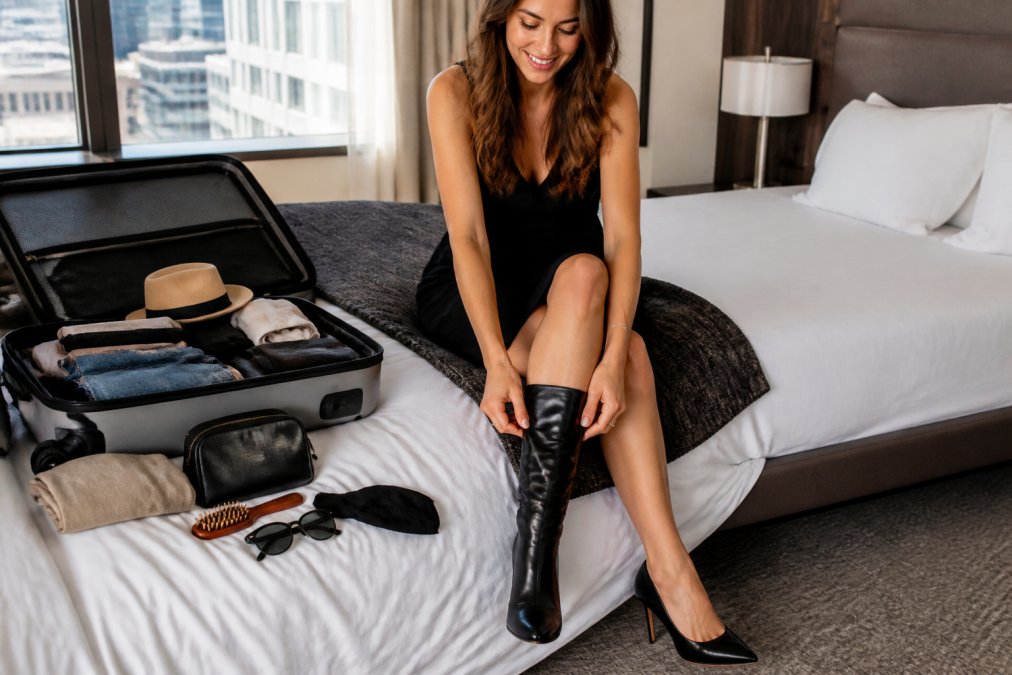
The Bootsy Best Boot Sleeve in Black is our flagship option at $35.99. It runs 23 inches from heel to opening and fits thigh circumferences from 14 to 60 inches across sizes XS to 5X, so it is sized by your leg measurement rather than your shoe size. That is the detail most boot brands get wrong, and it is why wide-calf shoppers struggle with standard retail sizing.
If you want a mid-calf look instead, the Mini Boot Sleeve in Chocolate Crocodile runs $29.99 and pairs with the same women's shoe sizes 6 to 11. For a bolder finish, the Vamp Boot Sleeve in Deep Cherry Vinyl at $35.99 adds a high-shine option to the same convertible system.


Boot Sleeves: The Space-Saving Solution
A boot sleeve is a stretch fabric tube that slides over an existing heel to create the look of a full boot. Because it is soft and collapsible, it packs flat in a corner of your bag, unlike a rigid boot shaft that holds its shape and eats volume.
Best Travel Shoe Organizers for Every Bag
The best travel shoe organizer depends on your bag, not your shoe count. For a carry-on, a slim shoe bag plus one compression cube covers two pairs. For checked luggage, a hanging organizer keeps everything visible and separated.
| Organizer Type | Best For | Space Saved | Packs Flat |
|---|---|---|---|
| Individual shoe bags | Carry-on, keeping soles separate | Low | Yes |
| Compression cube | Soft accessories, sleeves, insoles | High | Yes |
| Hanging organizer | Checked bags, multiple pairs | Medium | No |
| Drawstring pouch | Backpacks, gym-to-trip use | Low | Yes |
A dedicated shoe bag matters more than people expect. It stops a dirty sole from marking a clean outfit and gives damp or odorous shoes somewhere to sit until you can air them out.
Shoe Hygiene and Odor Management on the Go
Odor is the problem most packing guides skip, and it is the one that ruins a trip fastest. Moisture-wicking socks and a little airflow do more than any spray. Rotate shoes so each pair dries fully between wears, and never pack a damp pair sealed in a bag.
- Slip cedar or charcoal inserts into shoes overnight to absorb moisture
- Air shoes for at least a few hours after a full day of walking
- Pack a small pouch of baking soda to sprinkle in shoes before bed
- Wash fabric sleeves by hand and let them dry flat, since trapped moisture is what feeds odor
Fabric accessories like boot sleeves are easy to keep fresh because they are washable. That is a genuine advantage over leather boots, which need more careful, slower cleaning.
Sustainable and Eco-Friendly Shoe Care for Travelers
The most sustainable footwear choice is the one you already own, and accessories lean directly into that. Extending the life of a heel you have worn for years keeps it out of a landfill and out of your shopping cart. This is the angle most travel guides skip: they tell you what to pack, not how to keep it out of the trash.
Non-Toxic Cleaning That Travels Well
A small kit of plant-based or fragrance-free cleaners does the job without harsh solvents that can damage faux leather or vinyl. Avoid bleach, ammonia, and alcohol-based sprays on stretch fabrics (pubmed.ncbi.nlm.nih.gov). They break down elastic fibers, which is what makes a boot sleeve lose its hold over time. A mild soap and cool water is enough for most fabric accessories.
Sustainable Waterproofing
Repair Before You Replace
A repair kit is a sustainable accessory you can carry. When a sole starts to separate or a seam pulls, fixing it on the trip prevents the damage from spreading.
Care Habits That Extend Life
- Rotate shoes so each pair dries fully between wears
- Use cedar or charcoal inserts to absorb moisture and hold shape
- Store sleeves rolled, not folded, to prevent seam creasing
- Wash fabric accessories by hand in cool water and air dry flat
- Keep shoes out of direct sun, which fades color and dries out leather
Caring for what you pack is the same idea as buying less. A pair of shoes that lasts a decade beats three pairs that last a season. For travelers who care about footprint, buying one well-made accessory that multiplies your existing wardrobe is a smaller ask than buying new boots every year.
TSA-Friendly Footwear Accessories and Repair Kits
What makes an accessory TSA-friendly comes down to three things: it packs flat, it contains no restricted items, and it does not slow you down at security. Boot sleeves, insoles, shoe bags, and shoe trees all pass through without a second look.
Slip-on shoes speed up the security line, since you may need to remove them at the checkpoint. Check the current TSA guidance on what to expect at security before you fly, as procedures can change.
A small repair kit earns its place too.
For travelers worried about durability, this is the honest answer: any stretch accessory wears faster if you yank it on and off. Roll sleeves on gently, keep your nails from catching the fabric, and a well-cared-for pair lasts far longer than a rushed one.
Conclusion
Packing for a trip forces a hard choice between shoe variety and bag space, and most travelers lose that fight by overpacking. The fix is not more shoes, it is smarter accessories that make fewer shoes do more. Bootsy turns the heels you already own into thigh-high and mid-calf boots with a patent-pending sleeve sized by leg circumference from 14 to 60 inches, not shoe size, so it fits the body you have. Add a shoe bag, a compression cube, and a small repair kit, and you can travel with two pairs and still dress for every plan on the itinerary. Get started with Bootsy and pack lighter without giving up a single look.
Frequently Asked Questions
How can I pack fewer shoes for travel without sacrificing style?
Focus on versatile footwear accessories that multiply your options. A single pair of heels plus a boot sleeve can become thigh-high or mid-calf boots, giving you multiple looks from one shoe. Pack neutral colors that match several outfits, and use shoe bags to keep everything organized. This approach lets you bring fewer shoes while still having choices for day and evening.
What are the best ways to change the look of my shoes while traveling?
Boot sleeves are a standout option. They slip over your existing heels to create instant boots, no extra shoes needed. Look for stretch faux leather or vinyl sleeves sized by leg circumference for a comfortable fit. These small accessories take up minimal space and transform your footwear for different occasions.
How do I keep my shoes organized in a suitcase?
Use dedicated shoe bags or packing cubes to separate footwear from clothing. Place heavier shoes at the bottom of your suitcase, near the wheels, to balance weight. Stuff socks or small items inside shoes to save space. For boots or sleeves, roll them tightly and secure with a rubber band. Clear pouches help you spot what you need without unpacking everything.
Can I turn my existing shoes into boots for different climates?
Yes, with boot sleeves designed for travel. These stretch accessories fit over heels and some flats, creating a boot look without buying new footwear. Boot sleeves are washable and pack flat, making them ideal for adapting to changing weather.
0 comments