

Table of Contents
- Boot Sleeve vs Real Boots: Core Differences
- Anatomy of a Boot and How Sleeves Work
- How to Wear Boot Sleeves Over Heels
- Fit, Comfort, and Sizing: Real Boots vs Boot Sleeves
- Durability, Material Integrity, and Long-Term Wear
- Cost-Benefit Analysis: Investment vs Value
- Performance Features: Insulation, Waterproofing, and Weather Resistance
- Sustainability and Material Lifecycle
Last Updated: August 27, 2026
Boot Sleeve vs Real Boots: Core Differences
When shopping for boots, you face a fundamental choice: invest in traditional footwear or transform existing shoes with an accessory. Boot sleeves offer versatility without the price tag or storage headache, but they're not interchangeable solutions.
Real boots are engineered systems built with a sole, heel, shaft, and liner working together as a cohesive unit. A boot sleeve is a fabric covering that slips over an existing shoe to create the visual appearance and partial protection of a boot. This distinction cascades into real differences in durability, fit, comfort, and cost.
At Bootsy- The Boot Sleeve, we've analyzed what matters when comparing these options. The choice isn't about which is objectively "better", it's about matching the solution to your specific needs, body type, and lifestyle. Some people need the permanence and protection of real boots. Others find that boot sleeves solve their actual problem faster and cheaper.

Anatomy of a Boot and How Sleeves Work
Traditional Boot Construction
A real boot is a complete footwear system. The sole provides traction and durability, engineered to handle repeated stress from walking and environmental exposure. The heel (usually 1-4 inches) distributes weight and affects posture. The shaft extends from the sole up the leg, typically reaching mid-calf or higher, constructed from leather, suede, synthetic fabric, or a combination.
The liner provides comfort, moisture management, and insulation if designed for cold weather. Together, these components create a rigid structure that protects your foot and leg while providing arch support and ankle stability. A well-constructed boot distributes pressure evenly and maintains its shape through repeated wear.
How Boot Sleeves Fit Over Existing Shoes
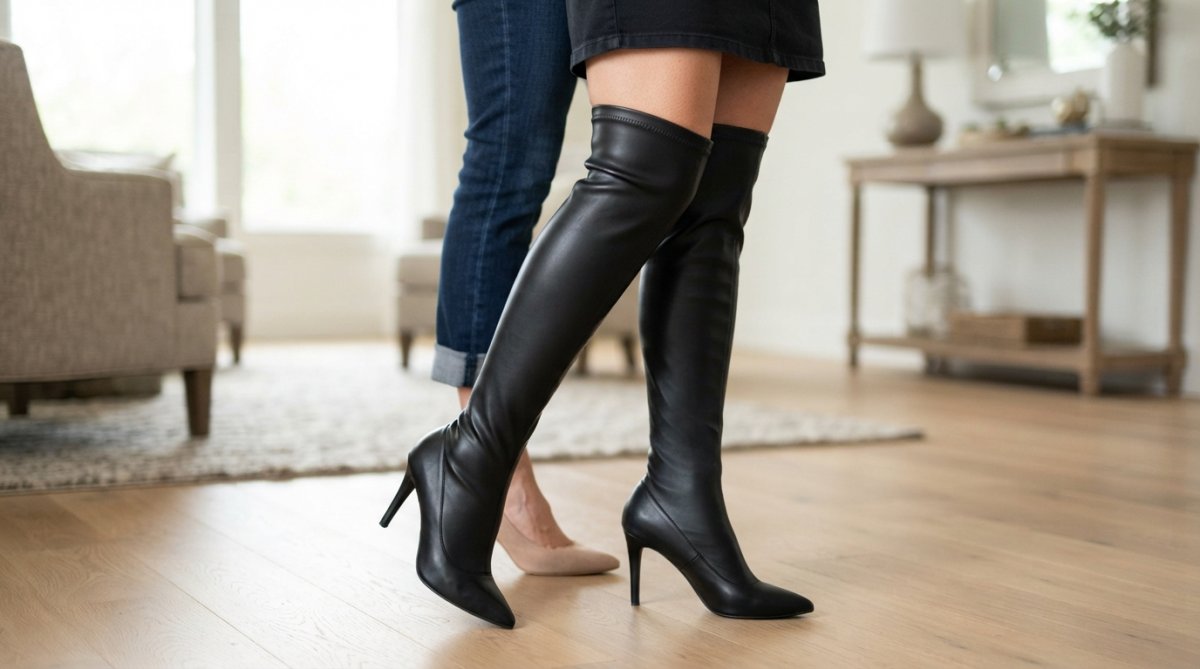
A boot sleeve is a fabric tube, typically made from stretch faux leather or vinyl, that slides over your shoe and up your leg. It doesn't replace the shoe; it covers it, creating the visual line of a boot extending from your ankle to your mid-calf or thigh.
The sleeve doesn't provide structural support the way a boot does. Your existing shoe remains the foundation. The sleeve adds visual continuity and some weather protection, but comfort, arch support, and stability come entirely from whatever shoe is underneath. A boot sleeve works because it solves a specific problem, the visual gap between your shoe and your leg, without requiring new footwear.
How to Wear Boot Sleeves Over Heels
Wearing a boot sleeve correctly matters. Done right, it looks intentional and polished.
Step-by-Step Application
Start by choosing the right shoe. Boot sleeves work best with heels that have a defined heel (at least 1.5 inches) and a closed toe. Stilettos, block heels, pumps, and kitten heels all work.
Measure your leg circumference where the sleeve will sit. For thigh-high sleeves, measure around the fullest part of your thigh. For mid-calf sleeves, measure around your calf. Bootsy- The Boot Sleeve, for example, offers sizing from 14 inches to 60 inches in circumference, XS through 5X, ensuring a fit that works for your actual leg.
Put on your shoe first. Sit down if wearing a thigh-high sleeve. Gather the sleeve at the top and slide it over your foot, then gently pull it up your leg. The sleeve should sit smoothly without wrinkles or bunches. Once in place, stand and walk a few steps. It should move with your leg without sliding down or restricting movement.
Preventing Slippage and Bunching
Slippage is usually a sizing issue. A sleeve that's too large will creep down as you walk. A sleeve that's too tight will bunch at pressure points and create visible ridges under clothing.
Use a soft measuring tape wrapped snugly around your leg at the point where the sleeve will sit. Choose the size that matches your measurement. Quality matters here. A high-quality stretch faux leather or vinyl sleeve grips your leg without squeezing.
Fit, Comfort, and Sizing: Real Boots vs Boot Sleeves
How Traditional Boots Fit
Real boots are constrained by shoe sizing logic, built around shoe sizes typically women's 5 through 13. But shoe size tells you the length of your foot, not the width of your calf or the circumference of your thigh.
This is why many people can't find boots that fit. A woman with a 16-inch calf might wear a size 8 shoe, but most size 8 boots are built for a 13-inch calf. Traditional boot manufacturers have tried to solve this with "wide calf" options, but these typically add width by only half an inch. For someone whose calf is 2 or 3 inches larger than standard, that's not enough.
Real boots also assume a certain body type, designed for an "average" leg shape. They fit some people perfectly and leave others with gaps at the ankle, pressure points, or a shaft that's too loose or too tight.
Inclusive Sizing for Boot Accessories
Boot sleeves approach sizing differently. Instead of starting with shoe size, they start with leg measurement. Bootsy- The Boot Sleeve sizes by thigh and calf circumference, 14 inches to 60 inches, rather than shoe size. This means a woman with a 22-inch thigh and a size 8 shoe can find a sleeve that fits her thigh.
A sleeve sized to your actual measurement will fit without gaps, pressure points, or slipping. It works for petite women, plus-size women, and everyone in between. The trade-off is that a sleeve works only with shoes you already own, but for many people, that's an advantage, they already have heels they love.

Durability, Material Integrity, and Long-Term Wear
How Real Boots Handle Daily Stress
A real boot is designed to absorb punishment. The sole takes the impact of walking and standing. The heel wears down and eventually needs replacement. Quality materials like leather or durable synthetics are engineered to flex thousands of times without tearing.
Weak points in traditional boots are usually the zipper, seams, and heel. A well-made traditional boot can last 3-5 years or longer with proper care (peer-reviewed research). Leather boots can last even longer if conditioned regularly and heels are replaced.
Boot Sleeve Durability Under Repeated Use
A boot sleeve faces different stresses. It's not bearing your weight; your shoe is. Instead, the sleeve experiences friction from being pulled on and off repeatedly and stress from stretching over your leg.
Quality matters enormously. A high-quality stretch faux leather or vinyl sleeve, engineered to handle repeated stretching and friction, should last 1-2 years of regular use (peer-reviewed research). That's shorter than a traditional boot, but significantly cheaper.
Cost-Benefit Analysis: Investment vs Value
Real Boot Pricing and Longevity
A quality pair of real boots costs between $100 and $300 for mid-range options (bls.gov). A $150 pair lasting 3 years costs about $50 per year to own. Hidden costs include heel replacement ($30-60), seam repair ($40-100), and leather conditioning. Each pair also takes up closet space.
Boot Sleeve Cost and Versatility
A quality boot sleeve costs $29.99 to $35.99. Bootsy- The Boot Sleeve thigh-high sleeves are $35.99; mid-calf sleeves are $29.99. There are no hidden costs, no heel replacement, conditioning, or repair.

The real value is versatility. One sleeve works with multiple shoes. A woman with five heels can create five different boot looks with a single sleeve. If a $35 sleeve works with five shoes and you wear it 50 times a year, that's $0.14 per wear. A $150 boot worn 50 times a year costs $3 per wear.
Performance Features: Insulation, Waterproofing, and Weather Resistance
Traditional boots designed for cold weather include insulation and waterproofing. The sealed construction means water doesn't seep in from the sides.
Boot sleeves offer partial protection. They cover your leg, adding a layer between your skin and the cold, and provide some water resistance. But they're not waterproof in the way a sealed boot is, and they don't provide insulation unless lined.
For serious winter conditions, real boots are the right choice. For mild weather or layering with other clothing, a sleeve over a shoe works fine. The advantage of sleeves is flexibility, if weather changes, you can remove the sleeve and wear your shoe as-is.
Sustainability and Material Lifecycle
Real boots are single-use items. Once worn out, they're typically discarded.
Boot sleeves extend the life of existing shoes. A heel that might have been worn out gets a second life as part of a boot look. You're getting more value from shoes you already own before they need replacement.
The real sustainability win is behavioral: sleeves encourage people to wear what they own instead of constantly buying new boots. That reduces consumption, the most effective sustainability strategy.
The choice between boot sleeves and real boots comes down to your specific situation. Choose real boots if you need serious weather protection, want a single investment that lasts years, or prefer the complete engineering of traditional footwear. Choose a boot sleeve if you want versatility, have a hard-to-fit size, travel frequently, or want to maximize your existing shoe collection.
For many people, especially those with sizing challenges or a love of variety, Bootsy- The Boot Sleeve offers a solution that real boots simply can't. The patent-pending design works with thigh measurements from 14 inches to 60 inches, ensuring fit for body types that traditional boots ignore. At $35.99 for a thigh-high sleeve or $29.99 for a mid-calf, it's an accessible way to transform your existing heels into stylish boots. Add to your collection and start creating new looks with shoes you already love.
Frequently Asked Questions
Q: What are the benefits of using boot sleeves over buying new boots?
A: Boot sleeves transform heels you already own into stylish boots without purchasing new footwear. They cost $29.99-$35.99 versus $100-$300+ for quality traditional boots. Sleeves work with multiple shoe styles, travel easily, and adjust via thigh circumference rather than restrictive shoe size, making them ideal for people with wide calves or thighs that struggle with standard boot fit. They're reusable, and let you create multiple looks from one shoe collection.
Q: How do you ensure a proper fit with stretch boot sleeves?
A: Measure your thigh or calf circumference where the sleeve will sit using a soft measuring tape. Boot sleeves are sized by leg circumference (14"-60") rather than shoe size, accommodating diverse body types. If your measurement falls between sizes, choose the smaller size for a secure hold. No tape measure? Wrap standard printer paper (11" wide) around your leg and use it as a ruler. Sleeves should feel snug without pinching or creating visible bulges.
Q: How do boot sleeves compare to traditional boots in terms of comfort?
A: Real boots often restrict width at the calf and toe box, creating pressure points. Boot sleeves made from stretch faux leather or vinyl move with your leg, eliminating squeezing and providing all-day comfort without stiffness. However, traditional boots offer more arch support and structural stability for long workdays. Boot sleeves excel at comfort for standing or casual wear; boots perform better if you need maximum foot support or walk uneven terrain frequently.
Q: Can boot sleeves be worn with any type of heel?
A: Boot sleeves work best with heels and pumps sized 6-11 that have a defined heel structure. Stilettos, block heels, and kitten heels all work well. Some flat shoes may work depending on their design, but sleeves perform optimally over heeled footwear because the heel creates a stable base and prevents the sleeve from shifting downward. Avoid very thin soles or extremely flexible flats, as the sleeve needs a firm foundation to stay in place throughout the day.
Q: Are boot sleeves a sustainable alternative to fast-fashion footwear?
A: Yes. Boot sleeves extend the life of your existing shoe collection by creating new looks without buying additional pairs. One heel becomes multiple boot styles, reducing consumption and waste. Sleeves are reusable, and durable when cared for properly. This approach cuts down on the material intensity and carbon footprint of traditional boot production. For environmentally conscious shoppers, sleeves offer a practical way to maximize wardrobe versatility while minimizing new purchases.
This article was written using GrandRanker
0 comments